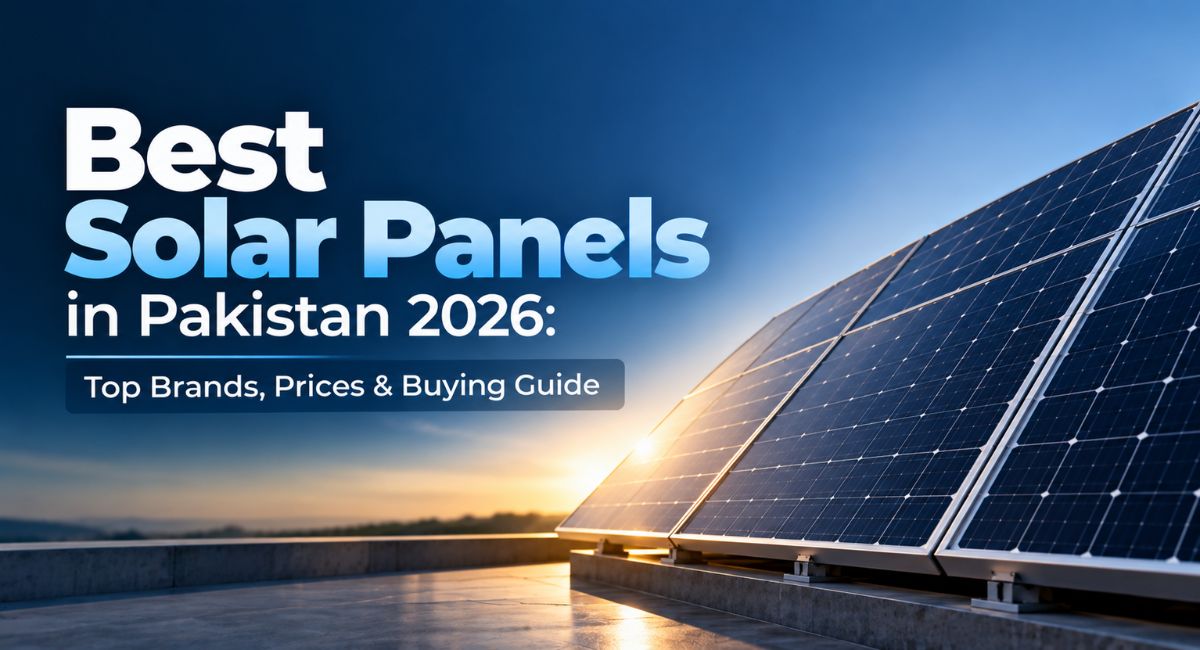
Choosing the Best Solar Panels in Pakistan is about more than finding the highest wattage or the lowest price. Your panel selection affects energy production, roof-space usage, system reliability, and long-term savings. In 2026, modern N-type solar panels and TOPCon technology are becoming increasingly popular because they offer strong efficiency and improved performance in demanding conditions. However, brands differ in efficiency, temperature coefficient, degradation, warranty, and pricing. Understanding these details can help you avoid costly mistakes and choose panels that suit your home or business. This guide compares leading solar panel brands, explains solar panel prices in Pakistan, and covers the key factors you should check before making a purchase.
The best solar panel brands in Pakistan include LONGi, Jinko Solar, JA Solar, Canadian Solar, and Trina Solar. These manufacturers offer modern module technologies across residential, commercial, and utility-scale applications. Their product ranges include N-type solar panels, TOPCon, HPBC, HJT, and bifacial designs.
However, brand recognition alone shouldn’t decide your purchase. Compare the exact model, efficiency, temperature coefficient, warranty, degradation rate, dimensions, and seller documentation. A 600W panel from one series may have very different electrical characteristics from another 600W module. The datasheet tells the real story.
Brand | Popular Technology | Example Series | Main Strength |
LONGi | HPBC / N-type | Hi-MO 9 | High efficiency |
Jinko Solar | N-type TOPCon | Tiger Neo | Heat performance |
JA Solar | N-type TOPCon | DeepBlue | Strong value |
Canadian Solar | TOPCon / HJT | TOPHiKu / HiHero | Broad product range |
Trina Solar | N-type TOPCon | Vertex N | High power output |
LONGi has become a major name in advanced photovoltaic technology. Its newer Hi-MO range includes advanced N-type and back-contact technologies, depending on the model. Current Hi-MO modules can deliver high efficiency while offering strong performance for rooftops where available space matters.
For smaller rooftops, higher efficiency can make a meaningful difference because you can generate more power from limited space. Always compare the exact Hi-MO model because specifications, warranty, dimensions, and cell technology vary between generations.
Jinko Solar’s Tiger Neo range uses N-type TOPCon technology and focuses heavily on high-temperature performance. A current 585W Tiger Neo specification lists 22.65% module efficiency with a temperature coefficient of approximately -0.29% per °C.
That matters in Pakistan because rooftop modules can operate well above standard test conditions. A lower temperature coefficient helps limit power losses as module temperature rises. Tiger Neo modules are available in both monofacial and bifacial configurations depending on the model.
JA Solar’s DeepBlue family represents its modern high-efficiency module platform. The range includes newer N-type technologies designed to deliver higher power output and improved long-term performance. Different DeepBlue models can vary considerably in efficiency, wattage, dimensions, and electrical characteristics.
For buyers comparing solar panel prices in Pakistan, JA Solar deserves attention because the purchase decision shouldn’t depend on wattage alone. Compare the exact model’s efficiency, degradation rate, warranty, temperature coefficient, and price per watt before purchasing.
Canadian Solar offers several advanced module families, including N-type TOPCon and HJT products. Its current portfolio covers different power ratings and cell technologies, giving buyers several options for residential, commercial, and larger solar installations.
HJT modules can be particularly interesting in hot climates because their temperature characteristics can support stronger energy yield under high operating temperatures. However, Canadian Solar specifications differ between product families, so check the exact datasheet before comparing prices.
Trina Solar’s Vertex N range focuses on high-power N-type modules. Current Vertex N products offer high wattage and advanced bifacial designs. For large installations, higher wattage can reduce the number of panels needed while potentially simplifying mounting and cabling requirements.
However, larger modules require careful roof planning. Check panel dimensions, structural loading, inverter compatibility, and available installation space before ordering. A high-wattage panel isn’t useful if the roof layout cannot accommodate it efficiently.
N-type and P-type describe the semiconductor doping used in the solar cell. N-type designs now dominate many newer high-performance modules because manufacturers can achieve strong efficiency with lower degradation characteristics. TOPCon, HJT, and several back-contact technologies use N-type wafers.
P-type panels aren’t automatically poor products. They simply represent a more mature architecture. If an older PERC panel has a substantial price advantage, it may still fit a particular project. For a new rooftop where space and lifetime generation matter, however, comparing modern N-type options makes sense.
.
Buying genuine modules matters as much as choosing a reputable brand. A manufacturer name printed on a frame doesn’t prove authenticity. Check the serial number, barcode, QR code, product label, packaging, and warranty documentation. Where the manufacturer provides verification tools, use the official source.
Physical inspection adds another layer of protection. Look for consistent frame construction, clean glass, intact junction boxes, undamaged connectors, and matching serial information. Ask the supplier for proper invoices and documentation. If a seller avoids basic verification requests, that should prompt closer scrutiny before payment.
“The cheapest panel is not always the cheapest solar investment.”
A panel’s real value comes from the electricity it produces over its useful life. Authenticity, installation quality, inverter matching, and maintenance all influence that outcome.
What is the price of a 585 watt solar panel in Pakistan today?
A 585W panel currently costs roughly PKR 23,000–27,000, depending on brand, technology, and seller.
Can I run 2 AC on a 5kW solar system?
Yes, but it depends on the AC capacity, other loads, sunlight, and inverter. Two efficient 1-ton inverter ACs can generally work with careful load management.
How many batteries are required for a 3kW solar system?
It depends on your backup requirement. For a typical 3kW system, one suitable 5kWh lithium battery can provide useful backup, while higher loads need more storage.
Which is better, Jinko or LONGi?
Both are excellent options; compare the exact model, efficiency, warranty, temperature performance, and price before choosing.
What are the top 5 solar panel brands?
The top 5 solar panel brands are LONGi, Jinko Solar, JA Solar, Canadian Solar, and Trina Solar. These manufacturers offer widely used high-efficiency modules for residential and commercial systems.
Choosing solar panels is a long-term decision, not a one-day bargain hunt. The strongest options in 2026 combine modern cell technology, high efficiency, controlled degradation, credible warranties, and genuine documentation. LONGi, Jinko Solar, JA Solar, Canadian Solar, and Trina Solar all provide serious options across different project requirements.
Before signing a quotation, compare the exact model numbers rather than just the brand names. Check the datasheet, verify authenticity, calculate the required roof area, and examine the complete system design. A well-matched panel can keep producing useful energy for decades, making careful selection far more valuable than chasing the lowest upfront price.
Get in Touch with Us
Quick Links
Contact Info
Copyright ©2026 Astonenergy. All Rights Reserved.
