
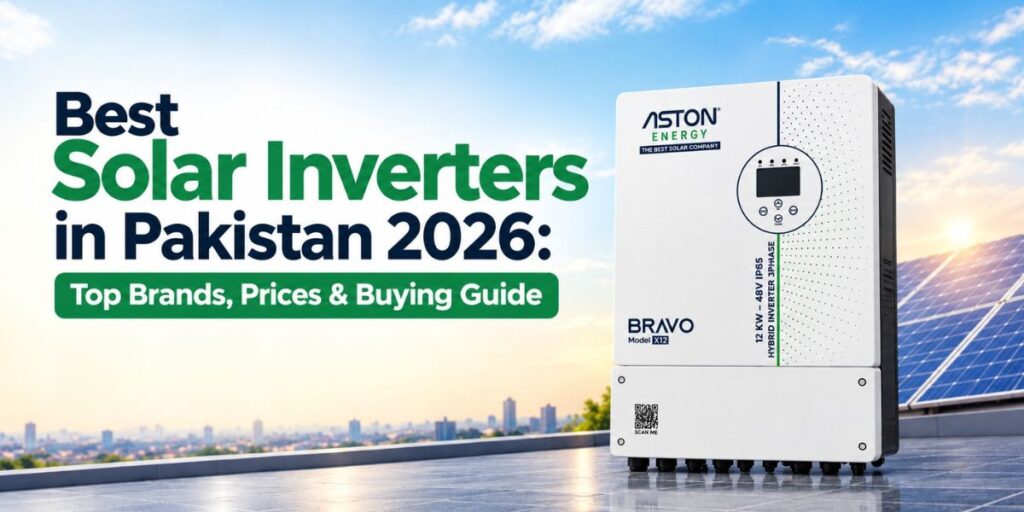
Choosing the Best Solar Inverters in Pakistan can make a major difference in your solar system’s performance, reliability, and long-term value. Your solar panels generate DC electricity, but your home needs usable AC power. That’s where a quality inverter comes in. The right inverter converts energy efficiently while managing your panels, batteries, grid connection, and household loads. In Pakistan, buyers can choose from on-grid, hybrid, and off-grid systems from brands such as Huawei, Sungrow, GoodWe, Growatt, Solis, Inverex, and Aston Energy. However, brand name alone shouldn’t decide your purchase. Solar inverter efficiency, battery compatibility, MPPT technology, warranty, monitoring, and after-sales support all deserve careful attention before you invest.
The Pakistani market offers several established inverter brands for residential and commercial installations. Huawei, Sungrow, GoodWe, Growatt, Solis, Inverex, and Aston Energy serve different system requirements. A premium string inverter may suit a grid-connected property. A hybrid solar inverter makes more sense when battery backup matters.
| Brand | Main Series | Common Application | Inverter Type | Battery Support | Monitoring |
|---|---|---|---|---|---|
| Huawei | SUN2000 | Residential & commercial | String / storage ecosystem | Selected models | FusionSolar |
| GoodWe | ES, ET, SDT | Residential & commercial | Hybrid / string | Yes, model dependent | SEMS |
| Aston Energy | Bravo Series | Residential & commercial | Hybrid | Lithium & lead-acid | LCD / communication options |
| Growatt | MIN, MID | Residential & commercial | String / hybrid | Model dependent | ShinePhone |
| Solis | S6 and other series | Residential & commercial | String / hybrid | Model dependent | Solis monitoring |
| Sungrow | SG Series | Residential & commercial | String / hybrid | Model dependent | iSolarCloud |
| Inverex | Various series | Residential | Hybrid / on-grid | Model dependent | Model dependent |
Solar panels produce DC electricity. Your household appliances normally use AC electricity. The inverter performs this conversion while controlling voltage, frequency, current, and energy flow. Modern equipment also uses MPPT tracking to keep solar panels operating near their most productive electrical point as sunlight changes.
A hybrid system adds another layer. It can direct solar power toward your appliances, battery, or grid according to the programmed operating mode. During an outage, compatible equipment can supply selected loads from batteries. That makes the inverter more than a converter. It becomes the control center of the entire solar power system.
An on-grid inverter works with the utility network and normally shuts down when the grid fails. A hybrid inverter can combine solar, grid, and batteries. An off-grid inverter works independently from the utility and relies heavily on battery storage. Your electricity requirements should determine which architecture you choose.
For homes that experience outages, battery-backed systems can provide greater energy independence. However, grid-connected installations require proper synchronization and anti-islanding protection. The inverter must also operate within the electrical limits of your solar array, battery, and local grid connection.
The solar inverter brands in Pakistan range from global manufacturers to companies with a strong domestic presence. Huawei, GoodWe, Sungrow, Growatt, Solis, and Inverex all offer different product families. Aston Energy adds locally available hybrid options designed around residential and commercial energy requirements.
Huawei’s SUN2000 range focuses on intelligent solar conversion and energy management. Current Pakistan specifications for the SUN2000-2/3/3.68/4/4.6/5/6KTL-L1 show maximum efficiency reaching 98.4%, two MPPT trackers, integrated WLAN, FusionSolar monitoring, and optional battery integration.
The series also includes protection features such as anti-islanding, DC reverse-polarity protection, surge protection, residual-current monitoring, overcurrent protection, and arc-fault protection. These features demonstrate why the exact technical specification matters when comparing Huawei solar inverter models rather than judging the entire brand by one product.
GoodWe has developed a strong presence in residential and commercial solar storage. Its Pakistan operation lists products including ES Uniq, SDT G3, ET, and other inverter families. The company also states that it operates equipped service hubs in Karachi and Lahore.
The product range covers different capacities, phases, and battery architectures. Its G3 Hybrid Series currently covers 8kW to 20kW models with a stated 10-year warranty on that series. For buyers focused on battery integration, GoodWe can be relevant when storage and backup form a central part of the system design.
The Aston Energy Bravo Series is designed for homes that need substantial output, battery support, and flexible load management. The current Bravo range includes the X6, X8, and X10. These models provide rated outputs of 6.6kW, 8.6kW, and 10.6kW respectively, with dual MPPT architecture and 48V battery operation.
The Bravo X6, X8, and X10 support maximum PV inputs of 12kW, 16kW, and 18kW. Each model uses two MPPT trackers, while the published specifications list IP66 protection, pure sine-wave output, Wi-Fi, RS232, RS485, and CAN communication. The system also supports dual output for smart load control.
Growatt’s MIN and MID families cover different installation sizes. MIN models generally target smaller systems while MID products extend toward larger installations. The correct selection depends on PV capacity, household demand, phase configuration, MPPT range, and whether battery storage forms part of the design.
Growatt also offers a broad ecosystem around solar monitoring, energy storage, and residential power management. Its broad availability can make it attractive for installers familiar with the platform. Still, buyers should verify the exact warranty, distributor, model number, battery compatibility, and local technical support before placing an order.
Solis offers string and hybrid inverter families across residential and commercial applications. Its products vary considerably in capacity, battery architecture, phase configuration, and MPPT design. That means comparing only the brand name can hide important differences between individual models.
Current Pakistan market references show Solis 5kW hybrid models around PKR 134,449–165,000. Larger three-phase hybrid models can cost substantially more. These prices demonstrate why solar inverter price in Pakistan should always be checked against the exact model and specifications rather than a general brand estimate.
Sungrow’s SG family includes grid-connected string inverter solutions while the wider Sungrow portfolio covers energy storage and hybrid applications. Its product range serves both residential and larger commercial solar installations. System designers should compare PV input limits, MPPT configuration, output phase, efficiency, monitoring, and battery compatibility where applicable.
The important point is scalability. A small home system and a large commercial array have very different electrical requirements. Choosing a Sungrow solar inverter therefore starts with the installation design rather than the brand itself. The exact SG model determines what the inverter can safely and efficiently handle.
Inverex is a familiar name in Pakistan’s residential solar market. Its portfolio includes hybrid products such as the Nitrox family alongside other inverter models. Current retail listings show an 8kW Nitrox around PKR 355,000 and a 10kW Nitrox around PKR 430,000. Retail availability can change quickly.
When comparing Inverex with other solar inverter brands, focus on the complete product specification. Battery voltage, PV input, MPPT range, phase configuration, warranty, monitoring, and service support all affect the real value of an inverter. A lower purchase price isn’t necessarily the lowest long-term system cost.
Start with your electricity load. Count the appliances that may operate simultaneously rather than adding every appliance’s nameplate rating without context. Air conditioners, pumps, refrigerators, ovens, and other motors can create significant demand. Proper inverter sizing should account for continuous consumption and starting surges.
Next, check the solar array and electrical connection. Your inverter needs suitable MPPT voltage and current ranges. Different roof directions may also benefit from separate MPPT channels. For hybrid systems, verify battery voltage and communication compatibility before purchasing. These details prevent expensive mismatches after installation.
A 5kW inverter doesn’t always need exactly 5kW of solar panels. Designers can use a larger PV array when the inverter’s specifications allow it. Solar modules rarely operate at their laboratory nameplate output throughout the day because heat, sunlight angle, dust, and weather affect generation.
The Aston Bravo range provides a useful example. The Bravo X6 has a 6.6kW rated output but supports up to 12kW of PV input. The X8 supports 16kW while the X10 supports 18kW. This shows why solar system sizing should use the complete electrical specification rather than a simple watt-for-watt assumption.
What are the top 5 solar inverters?
Leading solar inverter brands include Aston, Growatt, Solis, GoodWe, and Huawei.
How many ACs can 10kW run?
A 10kW solar inverter can typically run 3–5 ACs, depending on their capacity and the other connected loads.
Which brand solar inverter is best for home?
For home solar systems, Aston, Growatt, Solis, and GoodWe are popular options, depending on your system size and requirements.
What are the top 5 solar panel brands in Pakistan?
The leading brands include LONGi, Jinko Solar, JA Solar, Canadian Solar, and Trina Solar.
Get in Touch with Us

Quick Links
Contact Info
Copyright ©2026 Astonenergy. All Rights Reserved.
